Amtrak’s August 6 “Pop-Up” Session Revealed More About Their Outreach Method Than Their Plan
On August 6, Amtrak held what it calls a “Pop-Up” outreach session for the New Haven to Providence Capacity Planning Study next to one of the pavilions in Ninigret Park. This was the same night and at the same pavilion where a classic rock band was performing. That made hearing the discussions a challenge at times, and I apologize for any details I may have missed.
For its outreach, Amtrak is working primarily with an engineering and planning firm, HNTB Corporation, and it is the HNTB team managing this and future pop-up events.
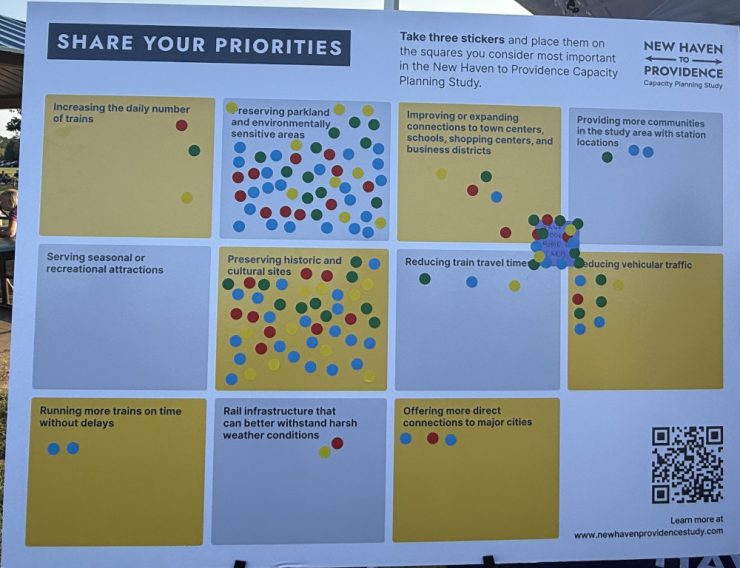
The August 6 “Pop Up” was not a presentation, but instead consisted of a table with pamphlets, a bulletin board on which members of the public could place three stickers they were given indicating the topics they were most concerned about, and one-on-one conversations with individuals from the outreach team wearing yellow t-shirts.
One representative from Amtrak (Joe Barr, Senior Director, State Partnerships and Development–East at Amtrak) was at the Ninigret Park “Pop Up.” The other individuals staffing the table and talking to the public were planners and individuals from HNTB’s stakeholder engagement team rather than Amtrak staff.
Most of what I saw and heard at the pop-up is already available at Amtrak’s Capacity Planning Study website and had been provided in two June webinars held for elected officials. However, the conversations with Mr. Barr and the HNTB team members were still enlightening.
Perhaps the most unexpected revelation was that they were starting with a “clean slate” and purposely not looking at the thousands of pages of comments entered into the NEC Future public record in 2016 and 2017.
Of course, everyone gets to comment now when we are in this “clean slate” mode, but the historic comments listed the important natural and cultural resources that NEC Future failed to discover ten years ago or decided to ignore at the time. That public record includes more than individual preferences, which should still be important, but it also has comments from organizations like The Nature Conservancy, National Trust for Historic Preservation, Westerly Land Trust, Town of Charlestown, and many others.
These comments don’t document every important resource in the entire area being studied, but these comments should inform the Study’s database of known resources that are at risk and irreplaceable. That data should be expanded; for sure, it shouldn’t have to be recreated.
And how will all these groups know they need to comment again? Most of the organizations that commented in 2016/2017 that are listed below, including towns that supposedly were already notified in late May 2026, are most likely not aware of the New Haven to Providence Capacity Planning Study or what is being studied. After 10 years, many people familiar with the railroad issue have left their government or organization jobs and been replaced with people who may not know the importance of carefully checking any train-related message.
Starting with the webinar that I attended in June, I’ve been asking the Study team specifically which governments, public officials, organizations, and agencies have been included in the Study’s outreach efforts. Each time I get my question repeated back as the answer, with a statement like “there has been outreach to federal, local, and state elected officials, etc.” It is important to know which towns have been told a new study is underway in order to know who has been left out, and to make sure they find out.
Finally, at the “Pop Up,” after asking and explaining a few times to different HNTB staff what I was asking, I was finally told that the outreach had consisted simply of an email that had been sent to each State Representative and each State Senator in the Study area. That’s good to know, but sending an email doesn’t mean that it was received, or that it was seen, or that the importance was recognized, or that it was forwarded to others.
In June, I did see an example of the email sent to state representatives. Nowhere in the email does it say the recipient is meant to send the message on to anyone else, or who received the message, or that it had anything to do with high-speed rail or rail realignments, or the “Old Saybrook to Kenyon Bypass.” Instead, the email said that the Study will evaluate “opportunities to expand Northeast Corridor capacity and improve performance.”
Unless someone had been closely involved in 2016, those phrases would not trigger recognition that this has something to do with that ten-year-old rail plan which, locally, would have crossed over Narragansett tribal land, over our Wild and Scenic Rivers, and through the center of 1,800 acres of permanently protected open space, which would have been fragmented and included the 1,112-acre Carter Preserve, farms, historic villages, and so much more.
None of this is meant to be a criticism of the Study team. The people I met on August 6 were very nice, but the outreach process seems to have some of the same flaws that outreach under NEC Future did ten years ago. The initial outreach from both this Study, and the previous NEC Future plan, give no hint that there may be rail realignments, more rails in our area, or a level of destruction that would cause irreparable damage to critically important conservation and historic areas.
When I asked which towns in the Study area have been contacted, one of the HNTB planners said they know locations by existing and historic train station names, not town names, so he couldn’t answer my question without consulting other maps or documents that he didn’t have at the “Pop Up.”
I know exactly where Kenyon is, but my Google alerts were set up for Charlestown in 2015 and didn’t pick up any news about the “Old Saybrook to Kenyon Bypass.” Groups working to stop the Bypass on the Connecticut end couldn’t find any information about a town named Kenyon. Kenyon is in Charlestown and Richmond. Were people in Richmond aware of the August 6 “Pop Up”?
It might be that Amtrak still doesn’t know quite where we all are. On August 6, one of the transportation planners in a yellow t-shirt expressed his reluctance to give up the existing rail alignment through Kingston Station and the Great Swamp Wildlife Management Area to Biscuit City Landing. It’s one of the straightest and fastest sections of the entire Northeast Corridor until it hits the small curve in Shannock and then another at Wood River Junction. If there are new rail lines, at least one team member’s preference would be to still reconnect with the existing NEC in Kenyon.
Also, Kenyon is about as far north as you can get in Charlestown, and Ninigret Park is about as far south. Although the devastating local impacts that would have been caused by the 2016 Bypass were not confined to Kenyon, and although much of the public in all of Rhode Island cares about places like the Carter Preserve, the Bypass is now a ten-year-old story, and random attendees at a Ninigret Park concert the night before the Seafood Festival likely included a high percentage of people who knew little about those issues.
Even so, despite little notice and a “Pop Up” location about as far away from the rail lines as you can get in Charlestown, the crowd was nearly unanimous in their desire to see environmental and cultural resources protected based on where they placed their stickers on the bulletin board. The banner image for this post is a photo of that August 6 sticker board.
 On the sticker board was an additional, home made topic box that said “Save our Home and Land,” that also received lots of stickers.
Links to Online Resources Mentioned in this Post
- New Haven to Providence Capacity Planning Study
- HNTB Corporation (formerly Howard, Needles, Tammen & Bergendoff)
- YouTube Video of June 17 Capacity Planning Study Webinar
- NEC Future
- Old Saybrook to Kenyon Bypass
Below is a list of some of the tribes, governments, and organizations whose substantive comments can be found in the record of NEC Future. Most are linked to copies of their NEC Future comments. “Clean slate” or not, these comments should be reviewed as part of the New Haven to Providence Capacity Planning Study, and each of these entities, where they still exist, need to be included in the new study process.
International Organizations
The Nature Conservancy
National Organizations
National Trust for Historic Preservation
NEC Commission (Membership from NEC states, Amtrak, and U.S. Department of Transportation)
Native American Tribes
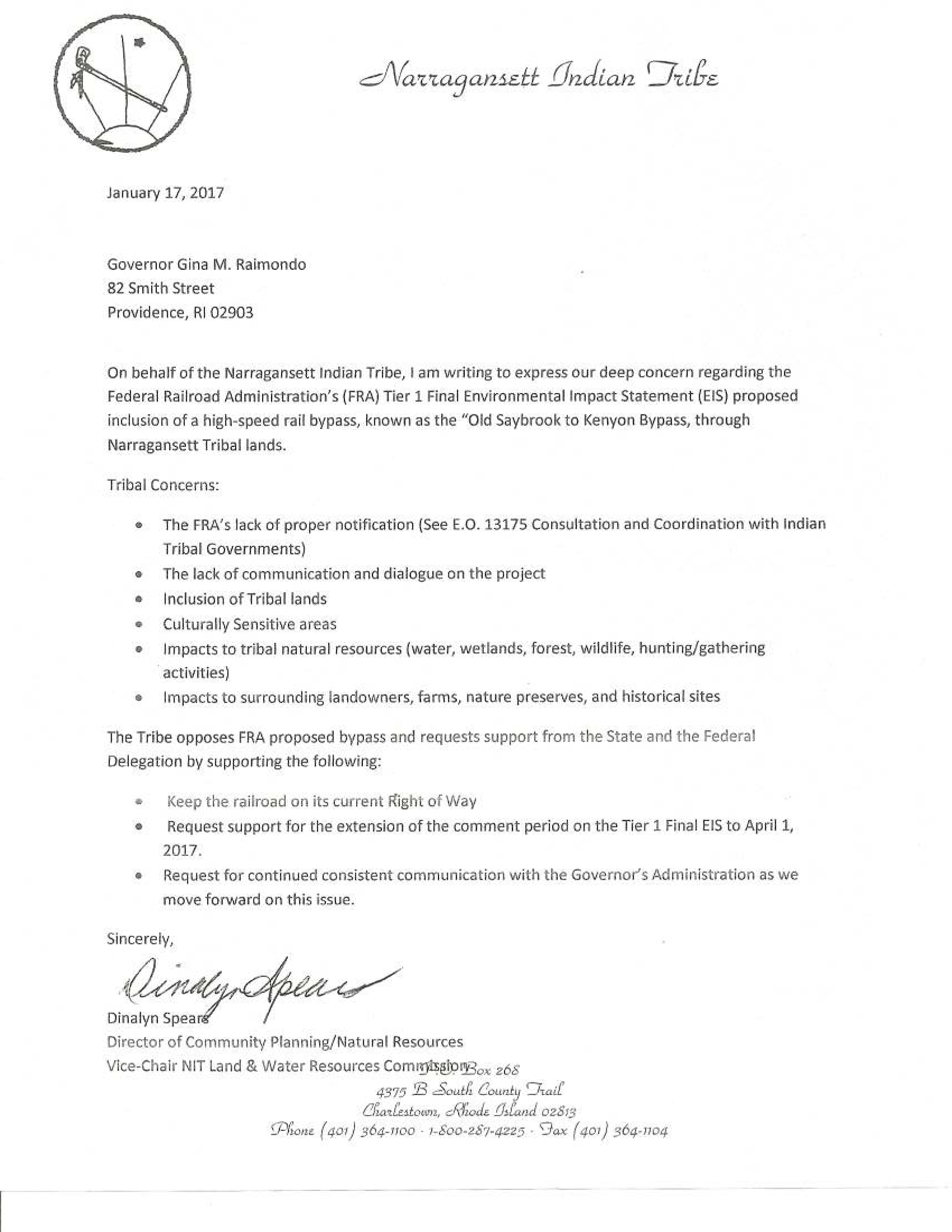
Narragansett
Mashantucket Pequot
Mohegan
Federal Agencies/Departments
US Fish and Wildlife Service
The United States Department of Interior
State Agencies/Departments
Rhode Island Division of Planning
Rhode Island Historical Preservation and Heritage Commission
Rhode Island’s Federal and State Delegations
Rhode Island’s Congressional Delegation
Rhode Island’s US Representative Jim Langevin
Rhode Island Governor Gina Raimondo
The Entire South County House and Senate members
Connecticut’s Federal and State Delegations
Connecticut’s US Senator Richard Blumenthal and US Representative Courtney
Connecticut’s US Senator Chris Murphy
Connecticut Governor Dannel P. Malloy
Connecticut State Senator Paul Formica
Connecticut State Senator Heather Somers
Connecticut State Representatives Joe De la Cruz, Chris Conley, and Devin Carney
Connecticut Deputy Secretary of State Scott Bates
Rhode Island State or Regional Organizations
The Wood Pawcatuck Watershed Association
The Rhode Island Land Trust Council
South County Tourism Council
Rhode Island Association of Railroad Passengers Opposes Bypass in Charlestown
Connecticut State or Regional Organizations
CT Trust for Historic Preservation
SECoast
Eastern CT Chamber of Commerce
Connecticut Fund for the Environment
Rhode Island Local Organizations
The Charlestown Citizens Alliance
The Charlestown Land Trust
Charlestown Agricultural Preservation Commission
Westerly Land Trust
South Kingstown Land Trust
Columbia Heights Home Owners
Greater North End Community Development (Westerly)
Ocean Community Chamber of Commerce
Connecticut Local Organizations
Greenwich Preservation Trust
Greenwich Historical Society
New London City Center District
Hodges Square Village Association
New London Landmarks
New London Political Parties
New London Main Street
The Riverside Park Conservancy
Southeastern Connecticut Enterprise Region
Mystic Seaport Museum
Mystic Aquarium
Mystic Chamber of Commerce
Rhode Island Municipalities
Charlestown Rhode Island
Richmond Rhode Island
Westerly Rhode Island
Hopkinton Rhode Island
South Kingstown Rhode Island
Exeter Rhode Island
Jamestown Rhode Island
Burrillville Rhode Island
Connecticut Municipalities
Lower Connecticut River Valley Council of Governments: Chester, Clinton, Cromwell, Deep River, Durham, East Haddam, East Hampton, Essex, Haddam, Killingworth, Lyme, Middlefield, Middletown, Old Lyme, Old Saybrook, Portland, and Westbrook
The Southeastern Connecticut Council of Governments: Bozrah, Colchester, East Lyme, Franklin, Griswold, City of Groton, Town of Groton, Jewett City, Lebanon, Ledyard. Lisbon, Montville, New London, North Stonington, Norwich, Preston, Salem, Sprague, Stonington, Stonington Borough, Waterford, and Windham
Greenwich

You can learn more about the author, Ruth Platner, at her profile page.
Thank you to Carla Ricci for the photos of the August 6 sticker board.
August 11, 2026 @ 9:50 am
Thank you Ruth for all this beautiful information. I was at the August 6 pop up and was very disappointed at the lack of information they had for us.