State Question 5 – Green Bond
On the November 3 General Election ballot is “Question 5 – Green Economy Bond.” Funding for various programs (listed below) is not to exceed $55,000,000 for environmental and recreational purposes.
In the past, Charlestown has received money from the Local Land Acquisition Matching Grant Program, funded by State open space and green economy bonds, to purchase South Farm, the Patricia Sprague Forest Preserve, Tucker Woods Preserve, and other projects. Under this program in 2022, Charlestown received $400,000 from the State to purchase the 100-acre Saw Mill Pond Watershed, but moving forward with that purchase was blocked by then-Town Councilors Deb Carney and the late Grace Klinger. Municipal open space preservation in Charlestown has stalled since the 2022 decision to decline that State grant.
Despite the apparent opposition to expanded land conservation in Charlestown from one or more of the current Town Council members, passage of “State Question 5” would provide the Rhode Island Department of Environmental Management (DEM) with funds to do its own land acquisition through the State Land Acquisition Program. These State funds can be used to purchase land that protects critical and uncommon habitats, supports rare or endangered species, expands other protected land, protects surface water bodies and groundwater for drinking water, and provides public access for recreation. As DEM says in promoting the bond,
protecting open space preserves our natural environment, expands recreational opportunities, and is key to building a vibrant economy and quality of place.”
Open space and green economy bonds have been consistently supported by 65% to 78% of Charlestown voters in every general election for over 25 years. We hope Charlestown voters will again vote for passage of these environmental bonds and also vote for members of the Town Council who will allow future open space bonds to be spent in our own town.
The Green Bonds are to be allocated as follows:
- Open Space Program – $3,000,000 for the State Land Acquisition Program allowing the State to acquire fee simple interest or conservation easements to open space, farmland, watershed, and recreation lands. The State would invest these funds in the preservation of iconic, scenic, and sensitive natural, agricultural, and recreational resources. The funds will be used to provide opportunities for Rhode Islanders and visitors to enjoy nature, hike, fish, and hunt. Funds are matched by federal, local, and non-profit sources, typically with each State dollar being matched by three other dollars.
- Agricultural Land Preservation Commission – $3,000,000 for the State to help protect Rhode Island’s working farms through the Agricultural Land Preservation Commission.
- Local Recreation Projects – $1,000,000 for the Outdoor Recreation Grant Program to award matching grants to municipalities to develop or rehabilitate local public outdoor recreational facilities such as parks, playgrounds, and athletic fields, and to acquire land for public recreational facilities.
- Resilient Rhody Infrastructure Fund – $25,000,000 to provide financial assistance to local governmental units for restoring and/or improving resiliency of infrastructure, vulnerable coastal habitats, and restoring river and stream floodplains. These funds will be prioritized to leverage federal, state, and local funds to support local programs to improve community resiliency, stormwater abatement and public safety in the face of increased flooding, major storm events, and environmental degradation.
- Facility Improvements – $12,000,000 for major capital improvements to facilities at State parks, beaches, and campgrounds. Facility improvements include new and upgraded visitor centers and restrooms, campsite enhancements, and infrastructure improvements.
- Narragansett Bay Watershed Restoration – $7,000,000 for matching grants to public and private entities to complete projects that restore and protect the water quality, aquatic habitats, and the environmental sustainability of Narragansett Bay and Rhode Island’s watersheds. The investments will advance work toward clean and safe waters for drinking water, shellfishing, recreation, commerce, and other valued uses. Eligible projects include, but are not limited to, improved stormwater management, green infrastructure, riparian buffer enhancement, aquatic habitat restoration including control of aquatic invasive plants, nonpoint pollution abatement projects, and flood mitigation projects that reduce long-term flooding risks while enhancing ecological functioning of ecosystems.
- Marine Infrastructure Development – $1,000,000 for improvements to public marine infrastructure such as boat launches and docks.
- Brownfields Remediation and Economic Development – $3,000,000 for the cleanup of former industrial or commercial “brownfield” sites that may be contaminated by hazardous waste or other environmental pollution. Funding is used to provide matching grants to public, private, and/or non-profit entities for brownfield remediation projects that bring sites back into productive use, return them to tax rolls, create jobs, and revitalize neighborhoods.
There is more information about the Green Bond at the DEM website.
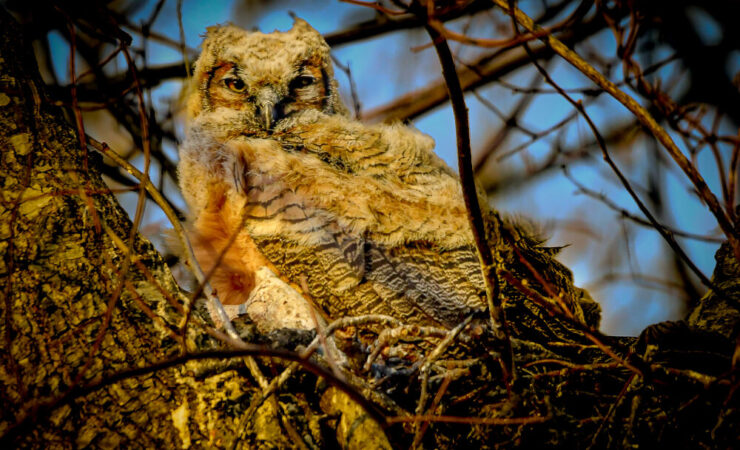
Banner image is a photograph of a Great Horned Owlet in Charlestown by John Zoldak. Protecting open space allows owls and other wildlife to reproduce and successfully raise their young for continuing generations of wildlife to survive, and for continuing generations of Charlestown residents to enjoy.