Protection Of Saw Mill Pond Watershed Blocked By Refusal To Go Forward With Appraisal
At the May 9 Charlestown Town Council meeting, Councilors Carney and Klinger refused to support the expenditure of $4,750 to fund a real estate appraisal to determine the fair market value of the Saw Mill Pond Watershed (Plat 25, Lot 10 on Rt. 112 – see maps below).
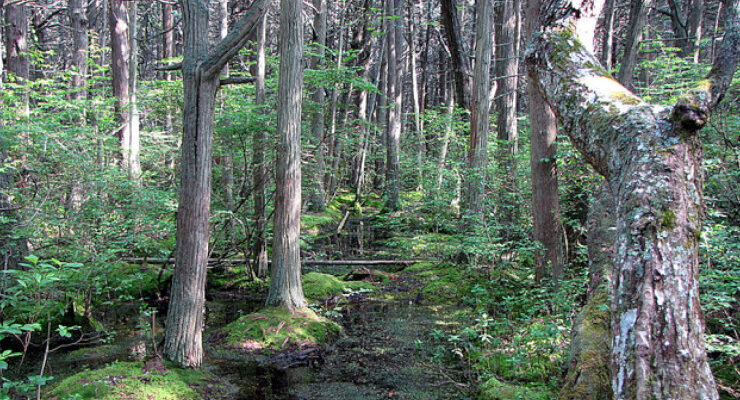
The Rhode Island Department of Environmental Management (DEM) awarded a $400,000.00 Natural Heritage Grant towards the purchase of the Saw Mill Pond Watershed that contains 100 acres of forestland in northern Charlestown. The property also contains an important wetland and wildlife complex that surrounds Saw Mill Pond. The land is part of a large area of unfragmented forest that includes Tribal land and the Francis Carter Preserve.
Land proposed for protection under the Natural Heritage Grant program is scored for its protection of critical and uncommon habitat, its capability of supporting a diversity of habitats, its support for rare or endangered species, its close proximity to other protected land, its close proximity to a water body, its importance for groundwater protection, and its public access for passive recreation.
Now that Charlestown has the grant, the next step is a comprehensive real estate appraisal. RI DEM will not provide funding to any project priced more than the appraisal, so this price must be determined. Doing an appraisal does not mean the project is approved. After the appraisal, the town and landowner would negotiate a price at or below the appraised value. The Planning and Conservation Commissions would then prepare detailed advisories to the Town Council, and the sale would then have to be approved by the Town Council at a public hearing and then by the RI DEM. Costs associated with the purchase would be funded by the $400,000.00 DEM grant with the rest from the town’s open space bond fund that was approved by Charlestown voters in 2015.
Town Councilors Bonnie Van Slyke and Susan Cooper, members from the Charlestown Land Trust, Planning Commission, and Parks and Recreation Commission, a URI Professor of Botany, and several others spoke in favor of getting the appraisal and working with the land owner and DEM to preserve this forested property that drains directly to Saw Mill Pond by dropping 100 feet in elevation over the property’s 3,300 feet in length from Rt. 112.
Councilors Carney and Klinger were concerned about taking this land off the tax rolls. The land currently pays about $2,500 in taxes. A realtor at the meeting said preserving the land would increase property values in the surrounding area, easily offsetting any lost taxes and that when the land is developed, the cost of maintaining roads, and providing other services, will far exceed the taxes collected. In the long term, preserving this parcel will have a net positive tax impact.
Councilors Carney and Klinger were not in favor of acquiring land that would require hiking trails and a trailhead parking lot because they believe it would result in more work for the Conservation Commission. The grant does require public access, but the property already has an access drive and an existing small parking area, and there are grants available from DEM and other groups for trail creation and maintenance. Karen Jarret, the President of the Charlestown Land Trust, also offered to be a partner to the Conservation Commission to help with planning and development of trails.
Councilor Deb Carney expressed her opinion that Charlestown has sufficient open space and that there is no development likely to happen that would impact this parcel. Planning Commission member Ruth Platner responded that since the 2015 open space bond was passed, we have preserved 151 acres. However, in that time 702 acres have or are being subdivided and developed resulting in 195 new residential lots or units, a number that does not count individual existing lots that were built on in those seven years. In addition there are over 400 acres being cleared and ground up for gravel. We are developing land at a much faster pace than we are preserving it. Others spoke about the fast pace of new construction in their neighborhoods and the likelihood that this pace will increase, because Charlestown is now a prime location for remote workers who only occasionally need to attend an in-person meeting in New York or Boston.
Councilor Clarkin has a family member who owns a home in the neighborhood to the north of the Saw Mill Pond Watershed and cannot vote to spend money on this acquisition because the home is within a radius that precludes voting. Without a third vote to support getting an appraisal, Councilors Carney and Klinger were able to block moving ahead with preservation of the Saw Mill Pond Watershed.
The $400,000.00 DEM grant will be lost if the acquisition is not completed in the next year.
Map showing property, wetlands and part of Saw Mill Pond

Map showing property, other tribal or private conservation land and Saw Mill Pond

June 5, 2022 @ 10:38 pm
I wholeheartedly disagree with the shameful decision by carney and klinger to block this. What an excellent opportunity this undeveloped parcel could hold for Charlestown in maintaining what makes it so special. Nature is already so rare in New England, losing tracts like this to development is a devastating loss. Especially for tracts that extend existing open space.
I would like to volunteer efforts to help land acquisitions like this be successful. Please contact me if I can help.
May 19, 2022 @ 9:24 am
The results of the townwide survey are being ignored by the two coucilors who do not want the town to acquire this property. They have not put the town back in Charlestown by ignoring the 90% who enjoy the ambiance of the town and the open spaces afforded them by the past administrations. The town spent about $100,000 for the survey and these councilors choose to ignore the results. A waste of money and a disregard for what the vast majority want.
May 16, 2022 @ 3:38 pm
I don’t understand this at all. There’s a generous National Heritage Grant for this and why in the world wouldn’t they approve the appraisal?
May 14, 2022 @ 6:30 am
This makes me so sad. It is incredibly important to preserve our wildlife corridor here in Charlestown. Particularly for bird populations which have declined so incredibly in the last decade. I do not understand the motivation for blocking this proposed appraisal. Just to save $2500 a year in taxes? We are at an environmental crisis in the world right now. Can’t Charlestown do our own little part?
May 13, 2022 @ 3:30 pm
We need to work together and find a way to preserve this parcel. Using any logical town, Land Trust or Open Space criteria, it meets all the check marks. In addition to being a great property for the purpose of Open Space, it is near contiguous with other open space, which adds to its value for people, plants and wildlife.
Lets find a way to make this happen!
May 13, 2022 @ 1:06 pm
Short term view by Carney and Klinger. Properties obtained by Land Trust are kept low maintenance. Since the Charlestown residents were supportive, why did they vote against getting the appraisal. Carney and Klinger appeared to confuse voting for the appraisal with a future vote to purchase the property.
May 13, 2022 @ 12:52 pm
Agree with above…Very sad. I won’t be voting for those two again.
May 13, 2022 @ 9:54 am
As I stated at the Town Council meeting, land once developed is lost forever from conservation protection. We are not always able to pick and choose which properties are available for conservation protection and need to expedite those that are of great value such as this property.
The open space in a cluster subdivision helps off set some of it but plants and wildlife is impacted regardless wherever development takes place: nesting, feeding, plant propagation and the wildlife value they provide for pollinators and other insects which are already declining, are adversely affected or lost. Our groundwater quality is important as are our ponds, salt and freshwater; all need protection. Pesticides and herbicides, lawn fertilizer etc can gradually flow into these bodies without adequate area to absorb them. Regardless, they can impact soil creatures necessary for soil health. So many things interact together to support healthy life, human and all other kinds. I realize that pressure for housing is increasing but it is vitally important that we preserve what we can before it is too late. In November we need to support those who actively support protection of our natural resources and provide responsible oversight for development for owners who currently have a right to develop their land. That oversight includes making sure regulations that protect our resources and town character are strong, clear and enforceable as much as possible. Rampant development can overwhelm a town .
The issue of maintenance is able to be dealt with later. It should be included in budgets and grants such as State trail grants sought. These have not been actively engaged in recently by the Conservation Commission as far as I know.
Volunteer Commission members have taken care of some of the necessary clearing but more is likely needed, either volunteer or paid. DPW assists also. Let us preserve the land now and work diligently to take care of all our land in posterity, including our own properties to ensure a healthy environment.