Legislative Commission To Study Groundwater Impacts Of New Housing
A new state legislative commission will study ways to evaluate, plan for, and limit the impacts of new housing developments on public water supplies and watersheds in rural areas under legislation sponsored by Richmond Representative Megan L. Cotter and approved by the RI House on June 8, 2026.
“We are in the midst of a very serious housing crisis that demands we create more homes. We also need to protect our water supply, so new and existing homes have the safe, clean water they all need. This isn’t an ‘either/or’ situation, it’s a ‘how,’ because both are essential. The question we need this commission to answer is how we determine and plan for the impact of housing on the water supply in rural areas, where most homes depend on private wells,” said Representative Cotter. “We need planning that looks at our water supply more broadly and into the future, because a safe water supply is not something we can afford to put at risk.”
The legislation (2026-H 8032) creates a new, 11-member House study commission consisting of three House members; representatives of the Department of Environmental Management, the Department of Health, the Water Resources Board, the R.I. League of Cities and Towns, and Rhode Island Housing; one manager of a water authority serving a municipality of fewer than twenty-five thousand in population; one manager of a water authority serving a municipality of greater than twenty-five thousand in population; and a professional who specializes in hydrology, environmental engineering and/or public health compliance of water systems.
The bill charges the committee with studying and providing recommendations for “evaluating, planning for, and limiting the impacts of new housing development on the safety, quality, and capacities of public water supplies and watersheds in rural communities.”
The commission is to report its findings and recommendations to the House of Representatives by June 15, 2027.
Representative Cotter’s original legislation was submitted in February and sought to give local communities greater control over the density of housing developments built on public drinking water supply watersheds and groundwater so clean it is classified as suitable for drinking without treatment. That bill did not pass, but the citizen lobbying and statehouse hearings in support of the bill did bring attention to the issue and worked to educate legislators about the unintended consequences to drinking water from high density housing development.
In Charlestown, all homes depend on wells and septic systems. To protect our drinking water and the health of our freshwater and saltwater ponds, our town has relied on zoning to maintain enough upland area to filter contaminants before they reach the groundwater. For this reason, 3-acre zoning districts sit on top of aquifers, and 2-acre zoning districts cover areas that recharge them. Our zoning is designed to protect our drinking water, enormous density bonuses are not.
We are hopeful that this new commission will produce recommendations that will protect our important ground and surface water resources.
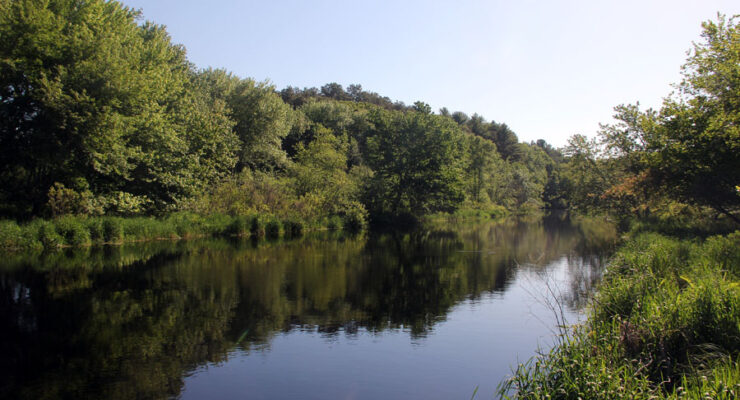
The banner image is a photo of the Pawcatuck River in Charlestown. In northern Charlestown, groundwater, and any nutrients or pollutants it might carry, flows to the river.
September 18, 2026 @ 6:29 am
Drinking water is vital for all of Charlestown. Protecting groundwater is high on our list. It deserves as much attention as housing, though both are important. I am glad zoning was implemented with this in mind. It should not be sacrificed for overdense development. A different approach to the housing issue is needed.