Amtrak Announces New Haven–Providence Capacity Planning Study To Begin
In 2016, the Federal Railroad Administration (FRA) released a plan to bisect Charlestown with new high-speed track that would have crossed into Charlestown from Westerly, run from Charlestown’s western edge to its eastern edge, and finally reconnected with the existing railroad near the Great Swamp State Wildlife Management Area in South Kingstown.
Land in Charlestown and Connecticut was squarely in the middle of the “Old Saybrook to Kenyon Bypass.” The Bypass was the “preferred alternative” in the Federal Railroad Administration’s Tier 1 Final Environmental Impact Statement (EIS).
More than 16 organizations worked tirelessly against the Bypass, including Greg Stroud and his organization SECoast, the Charlestown Citizens Alliance, and Charlestown’s Town Council.
When the Federal Railroad Administration released its Record of Decision on July 12, 2017, and dropped the “Old Saybrook to Kenyon Bypass” from the decision, it was great news and a big win for Charlestown. However, the Bypass was replaced by a required study that was needed to develop a new preferred alternative and that left Charlestown at risk for an alternative that would be similar to that of the Bypass.
At threat were many treasured natural and historical resources and private homes along the route, including:
- Grills and Riverwood Preserves on Charlestown’s western edge in Westerly
- Burlingame State Wildlife Management Area
- Homes in Burdickville village
- Working farms, including a fourth-generation family farm on top of Schumankanuc Hill
- Narragansett Tribal land
- The 1,112-acre Carter Preserve (owned by The Nature Conservancy)
- The Revolutionary-era Amos Green Farm
- Land protected by conservation easements
- Shannock Road, a state-designated Scenic Road
- Historic Columbia Heights housing
- Historic Kenyon
- National Wild and Scenic Pawcatuck River and Wood Pawcatuck River in Charlestown and Westerly
Amtrak made an announcement on May 21, 2026, that the study required by the FRA’s 2017 Record of Decision had finally received federal government and other funding to proceed. Amtrak estimates that the study—the New Haven to Providence Capacity Planning Study—will take up to two years,
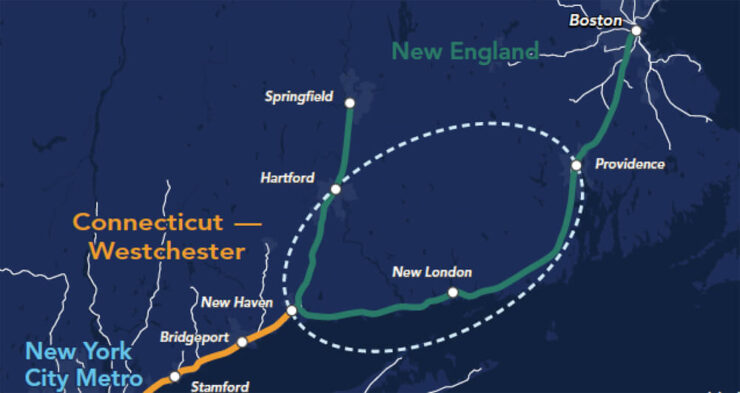
All we have at this point is a map with a giant circle covering our region and the many plans that have been undertaken since 2016. Nested in these short- and long-term plans is the “New Haven to Providence Capacity Planning Study.” The banner image in this post shows the study area.
In these plans is the following statement about the importance of the NEC:
[The NEC] is the busiest passenger rail corridor in the western hemisphere and a critical economic engine for the United States. Its mainline extending from Boston, MA, to Washington, DC, connects four of the nation’s largest metropolitan areas and moves 628,000 passengers each weekday on over 2,000 daily trains…. If it were its own country, the NEC would be the world’s third largest economy.
The study will be focused on the project planning phase, and it will evaluate “new potential rail alignments,” and is the opportunity “to complete the initial design work necessary to define the capital investment needed in this section of the NEC.”
Amtrak has pledged “careful consideration of environmental and community impacts and a strong commitment to robust public engagement.” “Careful consideration” does not guarantee the protection of the resources listed above. It will take every advocacy group that opposed the Old Saybrook to Kenyon Bypass to come together again to protect the Wild and Scenic Pawcatuck River, public and private protected open space, Narragansett Tribal land, historic villages, working farms, and so much more.
The selection of the new preferred alternative will be the outcome of the study. We’ll keep you updated as we learn more, and we may also need your help in contacting our federal and state officials as we move through the planning process. We are committed to protecting Charlestown and the natural resources and public and private property that would be destroyed if anything like the “Old Saybrook to Kenyon Bypass” returns.
Charlestown Town Council member Bonnie Van Slyke has placed this issue on the May 26, 2026 Town Council agenda.
The Connecticut Examiner has more on this story at https://ctexaminer.com/2026/05/23/amtrak-kicks-off-long-delayed-planning-for-high-speed-service-linking-new-haven-and-providence/ (Greg Stroud, is now the Editor-in-Chief at the Connecticut Examiner.)
Amtrak has produced an FAQ on the New Haven to Providence Capacity Planning Study.

You can learn more about the author, Ruth Platner, at her profile page.
July 8, 2026 @ 11:13 am
One valuable takeaway is that successful infrastructure planning depends on meaningful public participation. Involving local communities early in the planning process helps identify potential concerns, improve transparency, and build greater support for future projects.
May 26, 2026 @ 10:32 am
This will require community engagement to make our voices heard and our land protected as much as possible. It is easy for it to slip under the radar so we all need to keep our ears and eyes open to references to our area.
May 26, 2026 @ 10:02 am
I have said before and I will say it again. Wouldn’t it make more sense to go down the middle of the 95 corridor from providence to New London. Most of 95 from Warwick to Thames River has plenty of space between the northbound and southbound lanes. That would require less eminent domain for the tight spots or Elevated rails in the center.