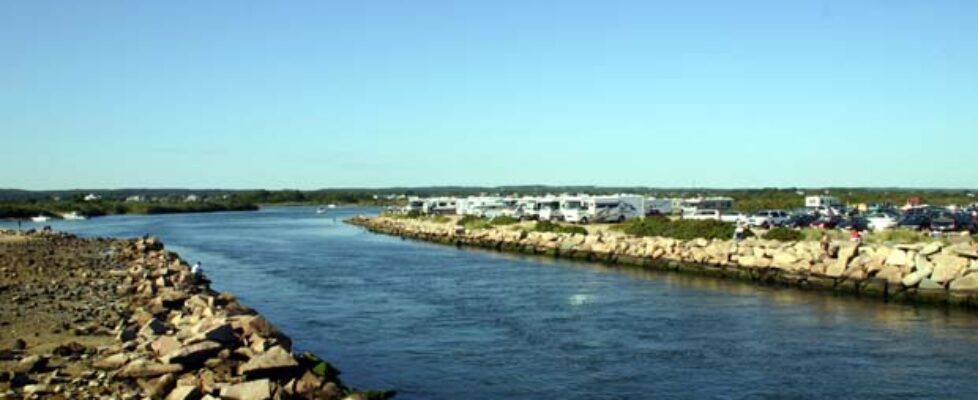
Report From Charlestown Breachway Repair Meeting
Many citizens learned more about the repair of the Charlestown Breachway and how the Breachway is faring over the summer at a meeting hosted by the Salt Ponds Coalition at the U.S. Fish & Wildlife Service’s Kettle Pond Visitor Center in Charlestown on August 7.
Stephen McCandless, who is Charlestown’s GIS coordinator and a coastal geologist; Emily Hall, who is a coastal geologist at the RI Coastal Resource Management Council (CRMC); and Alicia Schaffner, who is executive director of the Salt Ponds Coalition, reported that the project to repair the west wall of the Breachway, restore the dunes, and dredge the channel is funded and the project will go forward.
The Army Corps of Engineers’ permit is set, and the CRMC/DEM permits are expected in the next week or so. Regarding funding, $5 million will be provided by the state, and $2 million by the CRMC for the repair/restoration, and funds that have been put aside over the years in the town’s Beach and Pond Preservation Fund ($1.4 million) will be used for dredging.
By September 2026, it is anticipated that the project will be 90% complete. The “prep work” will begin on September 15. Then, after the campground at the Breachway closes on November 1, the major rock work (placing huge armor stones to protect the inner core of the wall) will begin and continue during December and January. When complete, the wall will be 8 feet high, on average, running from the area where the breach occurred landward. To arrive at the 8-foot height, anticipated future sea level rise and Nor’easters over the next 50 years were considered.
The channel will be dredged, likely between January and February. Approximately half the dredged sand will be placed behind the restored west wall of the Breachway and two artificial dunes will be placed; the remainder of the sand will be placed on the town’s beach.
Additional planting of the newly created dunes will occur after the plovers migrate in September. These planted areas will slowly grow and fill in over the next 10 years.
Casey Tremper from URI described the results of focus groups and interviews with 34 stakeholders, etc., and of an online survey of residents and visitors that was funded by the RI Infrastructure Bank, which also funded the engineering and design of the project. Questions were asked about attitudes, preferences, and concerns about the restoration project, place values, and climate resilience approaches in Charlestown. Of the 754 respondents to the survey, 84% were concerned about long-term climate change impacts, particularly coastal erosion, and 30% were moderately familiar with the Breachway restoration prioritizing public and boater safety, socioeconomic impacts, and balancing community and ecosystem needs.
Of interest will be a citizen science project to capture changes to the coastline over time. There will soon be two “CoastSnap stations” on the east side of the Breachway. These stations will consist of camera cradles on poles so that pictures can be taken, shared, and used to track how the coastline changes. One station is already in place and the second, which will face in the opposite direction (that is, to the east), will be placed shortly.
Below are answers to some of the questions regarding the project:
- The sandbar off the end of the Breachway is currently approximately 5 to 5.5 feet below the surface. Because of wave action, boaters are still advised to bear slightly to the left on exiting the Breachway (do not take a hard left turn!). However, because this sand continually moves with the tides, boaters are also advised to keep up to date with the latest information from Charlestown’s Harbor Master.
- The large vertical berm that has built up on the beach on the west side of the Breachway is protecting the area behind it and will be left as is during the project.
- It is expected that, after the channel is dredged, natural processes will repair the small beach across from the boat launch in the Breachway known as Elbow Beach.
- An old channel that meets the Breachway channel at a right angle (called the Link Channel) will not be dredged because the right angle will cause the channel to close quickly, because dredging would have little effect on the small amount of circulation between Ninigret and Green Hill Ponds, and because the organic sediment in the channel cannot be used on the beach. Art Ganz, President of the Salt Ponds Coalition, observed that this channel was originally constructed for fish migration and was intended to be closed seasonally.
- In the future, other areas of the Breachway that may need repair will be looked at. There are no plans to extend the Charlestown Breachway for a number of reasons, one of which is that an extension would cause sand to be eroded from the beach.
- Although there is no environmental assessment included in the funding for the project, a good deal of historical data exists and data about water quality are collected by the Salt Ponds Coalition and by oyster farmers in the Ninigret Pond. There will also be some monitoring of the project by URI.
Other questions concerned long-term plans regarding the Quonochontaug Breachway. Discussions are taking place regarding design work, etc. However, it was emphasized that these discussions are very, very early and that the project is not yet funded. Permitting will be applied for as soon as the Charlestown Breachway permits are received. Of interest, it is known that there was a lifesaving station there in 1887, but little is known about the construction of the existing Breachway. McCandless said there is evidence that it was constructed in 1962 (about 10 years after the Charlestown Breachway was constructed).
August 11, 2025 @ 10:20 am
The Quonochontaug Breachway was under construction in 1958.
August 11, 2025 @ 2:10 pm
Any information you have about the construction of the Quonnie Breachway would no doubt be appreciated by Steve McCandless. McCandless reported that he has not been able to find information about the construction of the Breachway and that he arrived at a date of 1962 for the construction because aerial images taken in 1960 show no Breachway and images taken in 1965 images show all three breachways in place.